Verona’s Villa Romana di Valdonega: how do you arrange a visit to its surviving rooms?

A visit to Villa Romana di Valdonega begins with a reservation question rather than a view of a grand intact house. The surviving archaeological area in Verona preserves part of a Roman residence, not a complete villa with every room waiting to be explored. That smaller scale is an advantage for a curious visitor. It encourages close attention to a floor, a threshold and the evidence that allows archaeologists to interpret a fragmentary plan.
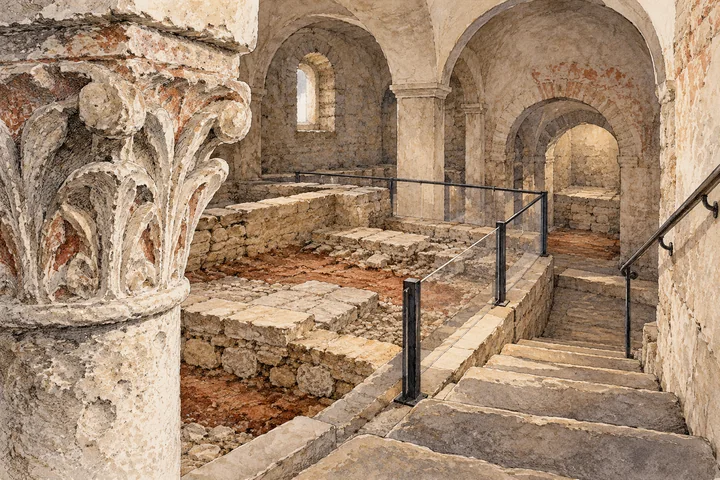
The city’s archaeological museum account dates the residence to the first century AD and describes remains discovered in 1957 during building work. Three rooms and an L-shaped portico survive, with a garden proposed in the interpretation of the arrangement. The word “proposed” is useful. It marks a reasoned reading of evidence rather than a licence to imagine every plant, activity or person who once occupied the place.
Confirm the appointment, not just the address
The managing association’s current visitor page requires booking. It gives the entrance as Via Cesare Zoppi 5, but its repeated timetable sections differ in their end times. Rather than reproduce one conflicting set of hours as certain, arrange the visit directly and use the confirmed appointment. Ask about the current admission or guided-visit terms, the meeting instructions and what happens if your plans change.
Explain any mobility needs before reserving. This is an archaeological site below the surrounding modern street level, and the visitor route should not be assumed step-free. A general description or an attractive photograph cannot establish whether a particular route suits your party. The association’s reply is more useful than an old copied timetable. Keep the confirmation available and allow enough time to find the actual entrance without hurrying.
Begin with what survives
Once on the authorised route, locate the edges of the rooms before concentrating on decoration. Where is there a clear wall line? Where does a floor continue beyond what you can see? Where does modern protection or support enter the picture? These questions help distinguish ancient remains from the arrangements that make a present-day visit possible.
Our guide to Roman Verona beyond the Arena provides a wider framework, but Valdonega deserves its own attention. A domestic site asks different questions from an amphitheatre or gateway. There is no need to turn every room into a confidently named activity zone unless the interpretation supports it. A carefully explained uncertainty can be more revealing than a neat reconstruction that exceeds the evidence.
Read a mosaic at two distances
From a permitted distance, look first at the organisation of the whole floor: borders, repeated shapes and the relationship between a decorated area and the room around it. Then attend to a smaller detail. The managing association describes geometric black-and-white work alongside coloured natural motifs, including plants and birds. Those descriptions invite observation, but they do not mean every detail will be equally visible from every point on the visitor route.
Do not step beyond barriers or lean into protected areas for a photograph. The mosaic is part of a fragile site, not a surface to test with a shoe or fingertip. If a motif is difficult to read, ask whether the guide has a photograph or explanatory image. A drawing can clarify a pattern while still remaining distinct from the surviving material in front of you.
Treat room names as interpretations
Archaeological terminology can sound more certain than it is to a first-time listener. If a guide describes a formal reception or dining space, ask which features support that identification. The answer may involve the room’s form, decoration and comparison with other Roman buildings. It does not necessarily identify an individual owner, a particular meal or an exact sequence of daily activities.
This habit transfers well to other Verona collections. At the Roman Theatre, architecture and later excavation shape the experience differently; at the Museo Lapidario Maffeiano, inscriptions and worked stone offer another kind of evidence. You can make the visits speak to each other without pretending that all objects belong to the same household, period or original setting.
Give a small site a complete visit
Leave time at the end to ask one question you could not answer by looking. Perhaps it concerns discovery, conservation or the relationship between the ancient building and the modern neighbourhood. The local open-gardens account supplies another perspective on the site’s setting, but a past special opening is not proof of ordinary access today. Your confirmed visit remains the practical authority for the day.
For a broader archaeological itinerary, Milan’s civic archaeological museum offers a different encounter between objects and surviving structures. Within Verona, compare the actual inclusions in our history collection; a city walk does not automatically enter Valdonega. The value of this visit lies in patient attention to what survives, and in knowing when a compelling story is supported by evidence and when it remains a question.
Sources & further reading
Turn a good read into a great day.
Find a highly rated Veronese experience that brings these stories to life.
Explore related experiences →