Verona’s Sant’Eufemia: how do you read a church that changed over centuries?

Sant’Eufemia is a useful antidote to the idea that a historic church belongs neatly to one style and one century. Its exterior and interior have been altered over a long period, so the most productive first question is not simply “How old is it?” Ask instead what has survived, what has changed and how the building’s present appearance gathers those different moments together.
The church is in central Verona near Porta Borsari and Ponte della Vittoria. It can form part of a city walk, but an interior visit needs its own opening check. Our Porta Borsari guide offers a nearby comparison in reading a monument carefully without assuming everything visible has one straightforward date.
Let the frontage raise questions
The official Verona tourism account distinguishes the church’s long building history from later changes to its appearance. It describes a brick facade with a neo-Gothic treatment and an earlier portal. That is a helpful warning against calling an entire frontage medieval because some of its forms look medieval.
Begin with the broad arrangement of the entrance and wall, then move towards individual details. What seems continuous, and where does the treatment change? Keep observation separate from dating: a difference in texture might be interesting without supplying its own explanation. If you want a closer photograph, leave other people room to pass and avoid turning the doorway into a stationary viewing platform.
Understand change as part of the history
Visit Verona traces the Augustinian building campaign from the late thirteenth into the fifteenth century, on a site with an earlier church. It also records later alterations and episodes of damage associated with military use. A building’s history includes these interruptions as well as its original ambitions.
That does not mean every visible feature should be assigned to a dramatic event. Read the interpretation for the specific connection. A sensible question is how an alteration affected the use of space: did it change movement, light or the way an artwork was seen? This invites you to consider the church as a place repeatedly used and adapted, rather than as a failed attempt to remain unchanged.
Give the long interior time to register
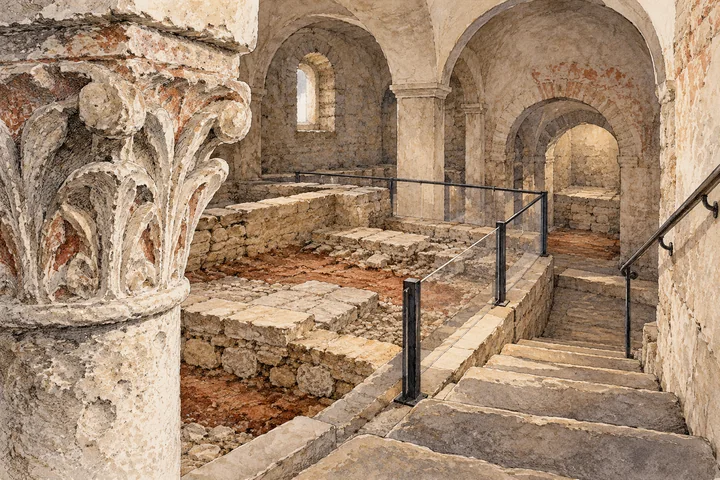
The official description emphasises the large single nave and barrel vault, with altars along the sides and a deep chancel. If the church is open for visiting, pause before proceeding. Notice how your attention moves between the length of the space and the smaller areas beside it. The structure can be experienced before you identify every object.
Our Sant’Anastasia guide offers a contrasting church visit. Compare what your eye does in the two interiors, rather than assuming that similar religious functions produce the same architectural experience. Leave enough distance between visits to remember one space before entering the next.
Choose one artwork instead of collecting names
Where access permits, select an artwork whose label and position you can study comfortably. The tourism account highlights Caroto’s scenes of Tobias in the Spolverini chapel, but a published mention does not guarantee that every associated area is accessible throughout ordinary opening. Follow the actual visitor route and ask if a particular work is your main reason for coming.
Look first at how an image tells its story through gesture, space and repeated figures. Then use the interpretation to confirm what is represented. Our Palazzo Maffei guide offers another approach to focused looking, in a very different museum setting. A remembered question is often more useful than a long list of artists immediately forgotten.
Check cultural visiting separately from Mass
The Visit Verona page checked on 22 October 2026 lists Saturday cultural visiting from 10:00 to 17:30 and provides worship information separately. Confirm current arrangements before travelling, particularly if planning another day. The diocesan parish directory provides the institution’s contact details. A service time is not an additional sightseeing slot.
Ask about the entrance and available route if you need step-free access or seating. During worship, keep photography and movement appropriate to local instructions. The Verona experiences collection can help organise the wider day, but verify whether Sant’Eufemia is a named stop with entry included. For a later Venetian comparison, consider San Sebastiano. Let each church keep its own history, pace and rules.
Sources & further reading
Turn a good read into a great day.
Find a highly rated Veronese experience that brings these stories to life.
Explore related experiences →