Verona’s Santa Maria Antica: what can a small church reveal beside the Scaliger tombs?

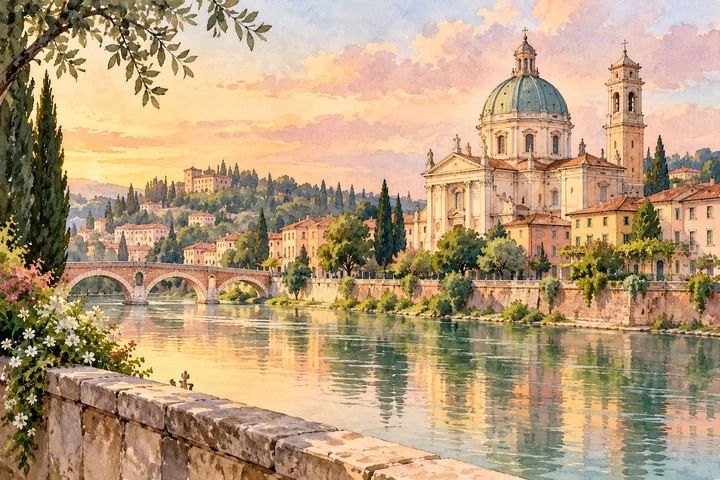
Beside Verona’s elaborate Scaliger tombs, Santa Maria Antica can seem almost modest. That difference is the reason to give it your attention. The small church and the dynastic monuments next to it belong to a connected setting, but they ask different questions. One draws you towards a place of worship and its changing fabric; the other makes the public presentation of family power difficult to miss.
Begin with the relationship rather than a photograph of the most ornate detail. Where does the church sit among the surrounding buildings? How do you approach its entrance? What is visible from the public space, and what requires separate access? Our closer look at the Scaliger tombs provides the companion story, while this visit gives the smaller building room to be more than a backdrop.
Look at the wall before the dates
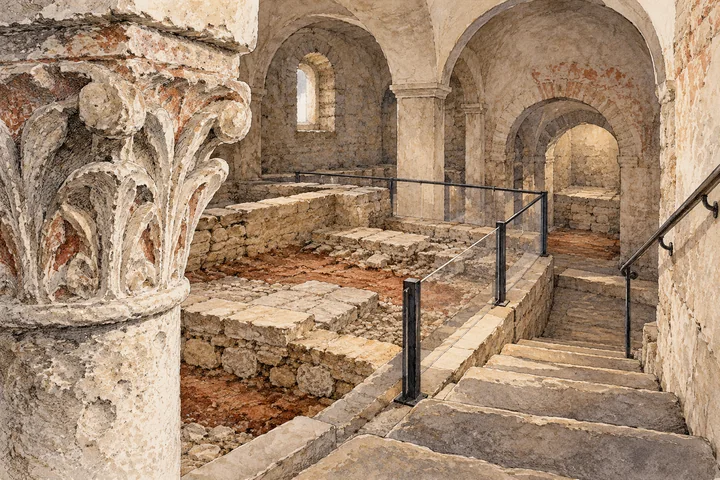
The official national tourism account describes the alternating brick and pale stone of the church. Notice the rhythm of those courses and the relationship between wall surface and openings. The side approach is part of the experience: a church embedded in a living urban block does not necessarily present the grand frontal view that visitors expect from a cathedral square.
Try a simple exercise. Describe the building without using the word “old”. You might mention its scale, materials, position and the way its entrance directs your movement. Only then add the historical information. This prevents a label such as “medieval” from doing all the work of looking. The same method is useful at Verona’s San Lorenzo, another church that rewards close attention to structure.
Distinguish the foundation from the present appearance
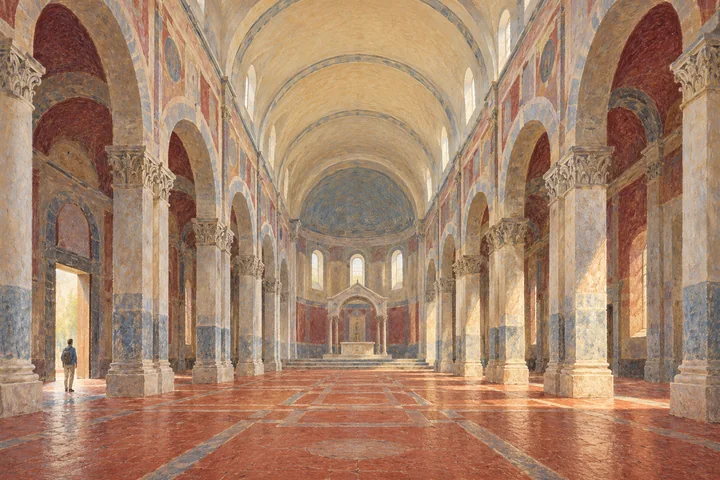
Santa Maria Antica has early medieval origins, while the church described by the official account was rebuilt in the twelfth century and consecrated in 1185. Later alterations also matter. Its present medieval character owes something to restoration between the late nineteenth and early twentieth centuries, when earlier Baroque changes were removed. What looks coherent today can therefore be the result of deliberate choices made long after the Middle Ages.
That does not make the building false or uninteresting. It adds another historical layer. Ask what a restoration was trying to reveal, and what it chose to suppress. Avoid treating every visible feature as untouched evidence from a single date. A useful comparison is the reconstructed Ponte Scaligero, where the relationship between surviving evidence and later work is especially important to understanding the view.
Keep church visiting and tomb admission separate
The neighbouring funerary enclosure has its own arrangements. The official Arche Scaligere listing includes dated visiting information and booking guidance; consult the notice relevant to your actual day rather than relying on an undated summary of the usual season. Seeing a monument from outside and entering an enclosure are different experiences, and neither establishes that the church interior will be available at the same time.
If Santa Maria Antica is open, enter quietly and check whether worship is taking place. Keep conversation low, follow photography instructions and avoid turning a small interior into a waiting room for the next attraction. Anyone who needs a particular access arrangement should ask directly about the route. A compact church is not automatically a step-free one, and nearby monuments may have different limitations.
Give the setting one clear place in your day
This is well suited to a focused stop rather than a rushed attempt to visit every central church. After looking, choose one relationship to remember: brick against stone, the church beside the tombs, or a restored surface beside a documented early foundation. A specific observation is more useful than trying to carry away a complete list of dates.
For a guided historical route, compare our Verona history experiences and check which interiors, if any, are included. On a wider trip, Milan’s Sant’Ambrogio offers a different example of a church whose long history cannot be reduced to one visible style. Santa Maria Antica’s reward is precisely its scale: it makes you slow down enough to distinguish a building’s continuing life from the impressive monuments gathered around it.
Sources & further reading
Turn a good read into a great day.
Find a highly rated Veronese experience that brings these stories to life.
Explore related experiences →