What should you know before visiting Verona’s Roman Theatre?

Verona's Roman Theatre is a different experience from the Arena: a hillside archaeological setting across the Adige, combined with a museum above the seating. Plan it as a place to explore layers of history and changing levels, rather than a quick second version of the city's famous amphitheatre. The distinction makes both monuments more interesting.
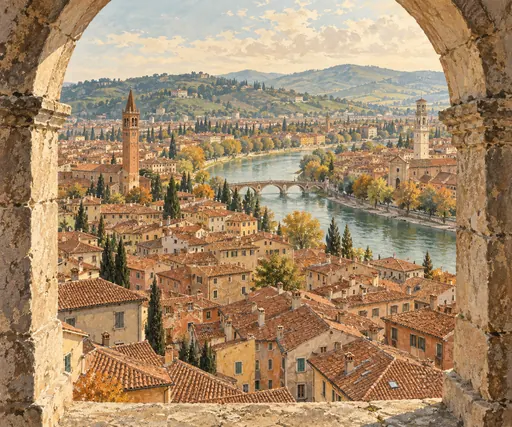
The official Verona guide dates the theatre to the end of the first century BCE and places it on the slopes of San Pietro hill, facing the ancient city across the river. That relationship is worth keeping in mind as you approach. The water and hillside help explain the site, instead of merely providing scenery for photographs.
Know which kind of Roman venue you are visiting
A theatre organizes attention toward a stage, with a semicircular auditorium. An amphitheatre surrounds an arena. Look at the basic plan before thinking about the small details: where would the audience face, how might people reach their seats, and what does the hillside contribute? Those questions are easier to answer on site than a long list of architectural terms. If Rome is also on your route, our sister publication’s guide to reading the Colosseum offers a useful comparison: look at how an amphitheatre gathers its audience around the arena, then return to the theatre’s focus on a stage.
Our guide to Roman Verona beyond the Arena provides a broader context. If you are choosing between sightseeing and an evening event, the Arena tour-versus-performance guide explains another important distinction: admission to inspect an ancient building is not the same purchase as a seat at a scheduled show.
Read survival and rebuilding together
The theatre visible today is not an untouched ancient building. Visit Verona notes that the auditorium steps were substantially rebuilt in the early twentieth century and that parts of the upper arcade are reconstructed. Rather than seeing this as a disappointment, use it to ask how archaeological sites are made understandable and usable for later generations.
Look for differences in materials and surfaces, but do not assign dates to every stone by color alone. Weathering, cleaning and repair can complicate what the eye thinks it knows. Site labels and the museum's explanations should guide your interpretation. A good visit can include uncertainty: “I can see a change here, but I need evidence to know what it means” is an excellent archaeological observation.
Allow time for the museum above
The civic museum's description explains that the entrance passes through Palazzo Fontana and that the collection occupies a former monastery built above the ancient remains. The displays include material connected with the theatre and other parts of Roman Verona. You are visiting a sequence of spaces, not simply looking into an outdoor bowl from a doorway.
The museum's historical account identifies Andrea Monga's nineteenth-century excavations and the establishment of the archaeological museum in 1923. Those later chapters matter because they explain why the ancient theatre re-emerged within a city that had continued to build and live around it.
Choose a small number of objects to connect with the architecture below. A carved fragment may reveal something about the visual richness that is difficult to imagine among plain surviving walls. Read its findspot and description before assuming it originally belonged to the exact part of the theatre where you are standing.
Plan for levels, weather and your own pace
The hillside setting means that the route deserves more thought than a flat museum corridor. Check current accessibility information with the venue if steps, slopes or extended standing could affect anyone in the party. Ask about the precise areas you hope to reach and the assistance available. A broad accessibility label does not describe every portion of a complex archaeological site.
Wear footwear that suits uneven surfaces and leave room for a pause. Outdoor sections change with heat, rain and light, so carry what your day's conditions require. Keep children close near changes of level and follow barriers rather than treating ancient seating as a playground. Our Ponte Pietra walk can provide a gentle approach, with the museum as the day's main appointment.
Keep performances and onward plans separate
The theatre also hosts events, and modern staging may be present when the performance programme requires it. Confirm current visiting arrangements and purchase any performance ticket for the specific event; a museum admission does not establish a booking for a show. Compare Verona landmark experiences for actual inclusions and the selected date.
Afterward, resist adding every nearby climb to the plan simply because the hill continues upward. Cross back toward the city for a meal or a quieter riverside interval if that suits the group. You will have seen ancient entertainment, later religious occupation, excavation and museum-making in one connected setting. That is already a substantial chapter of Verona.
Sources & further reading
Turn a good read into a great day.
Find a highly rated Veronese experience that brings these stories to life.
Explore related experiences →