Verona’s San Tomaso Cantuariense: how do you plan a church visit beyond the river?

San Tomaso Cantuariense is a good reason to extend a Verona walk beyond the familiar sequence of central squares. The church lies across the river from the historic core, near Ponte Nuovo del Popolo, and rewards attention to a façade, a reused doorway and the different activities that can share a sacred building.
Begin by deciding what kind of visit you want. Looking at the exterior, entering quietly during suitable visiting hours and joining an organised itinerary require different arrangements. The church remains a place of worship, so a traveller’s interest in architecture needs to fit around the life of the parish.
Who is the church’s Tomaso?
The dedication refers to Thomas Becket, associated with Canterbury, rather than to the apostle Thomas. The Diocese of Verona’s parish listing identifies the parish and its address at Stradone San Tomaso. That is useful confirmation when similar saint names begin to blur during a church-filled Italian journey.
The dedication can prompt a worthwhile question: how do stories and devotions travel between places? You do not need to turn the visit into a complete biography of Becket. Start with the name you can establish, then allow the building and its interpretation to supply the next layer. Avoid assigning a particular image to the saint simply because it appears in the church that bears his name.
Look at a façade that did not become a single finished statement
Verona’s municipal account of San Tomaso describes the church’s Carmelite history and its fifteenth-century rebuilding on a site associated with earlier churches. It also notes the unfinished façade and the prominent rose window. This is an invitation to look at relationships between parts rather than expecting a perfectly unified front.
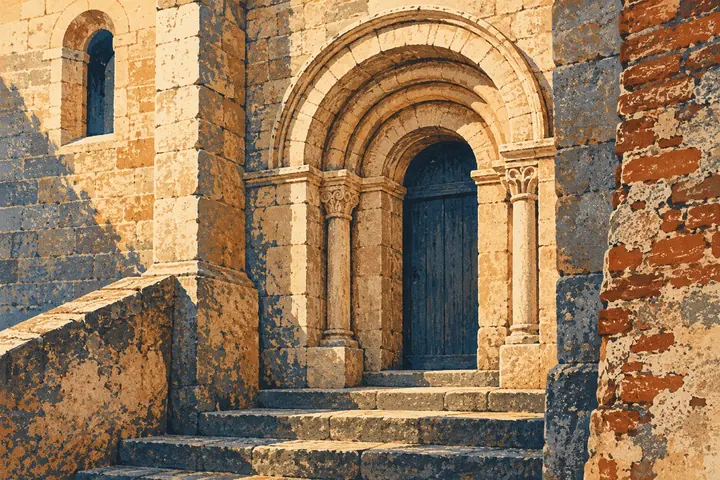
The same account identifies the carved doorway as a reused element, transferred from Santa Maria Mater Domini in Valdonega in 1518. A doorway can therefore carry a history that is not identical to the wall around it. Look at its scale and material against the surrounding surface, then ask what the move changes in your reading of the façade. Reuse is evidence of a building’s continuing life, not automatically a defect to be mentally corrected.
Let the interior set the pace
If the church is open for visiting, enter quietly and establish where visitors are welcome before moving towards individual works. A service, private prayer or a temporary restriction can change what is appropriate. Do not assume that every side space is available because the main door is open.
The municipal description mentions the church’s organ and its association with the young Mozart. That historical connection is not an announcement of a concert on your date. For a musical event, look for a current programme with the venue, date, admission conditions and organiser clearly identified. A silent organ can still be an interesting object within an architectural setting; it does not need to be performing to justify your attention.
Choose a small number of things to notice rather than searching for every named work. How does light fall into the nave? Where does an architectural frame direct your eye? Which details require a closer view, and which are better understood from farther away? These questions work even when a label is brief or your time is limited.
Check the visiting arrangement that applies now
The Verona Minor Hierusalem “Rebirth from Heaven” itinerary includes San Tomaso among its churches and describes Saturday visiting supported by volunteers. Checked on 27 October 2026, its stated Saturday window is 10:00–17:30. Confirm current exceptions before planning a visit around that window, especially if this church is the main reason for your journey.
An itinerary description is not the same thing as a confirmed guided booking. Contact the organiser for a group or a guided arrangement, and consult the parish for worship information. Older calendar entries embedded in a page should not be read as this week’s service schedule. A little precision here prevents a disappointing arrival at the wrong time.
Keep the neighbouring museum distinct
The National Archaeological Museum’s building account describes the former Habsburg prison now used by the museum, on land associated with the Carmelite complex. It is a separate attraction with its own entrance and visiting arrangements. Proximity does not create a combined admission or an internal route from church to museum.
Our National Archaeological Museum guide helps you choose that additional visit. If you would rather continue on foot, the Veronetta walk supplies wider neighbourhood context, while Santa Maria in Organo offers a different focus on church interiors and craftsmanship.
For another city’s example of architecture shaped by religious use, consider Milan’s divided church of San Maurizio. Keep the comparison specific rather than assuming the two buildings share a history. Our Verona experience collection can help with a guided city plan, but check whether San Tomaso is actually included. The most rewarding visit may simply be a carefully timed pause in a working church, with enough context to recognise that its doorway, organ and neighbouring buildings tell different stories.
Sources & further reading
Turn a good read into a great day.
Find a highly rated Veronese experience that brings these stories to life.
Explore related experiences →