Verona’s San Giovanni in Valle: how do you plan a visit to its crypt and church?

San Giovanni in Valle rewards the visitor who makes a small, deliberate plan. This church in Verona’s eastern neighbourhoods brings together Romanesque architecture, a crypt and older funerary material, but those interests do not guarantee unrestricted opening. Begin with the current welcome schedule, then decide how much of your day should depend on entering. A church visit works best when the building’s religious life and the visitor’s curiosity are allowed to coexist.
When is the visitor welcome available?
At our review on 25 October 2026, the current Italian Verona Minor Hierusalem church page and its information page give Saturday 10:00–17:30 for the volunteer welcome service. Older English and tourism descriptions may show a broader schedule. Use the current Italian information and confirm arrangements before a special journey, particularly if the crypt is your main interest. Sunday 25 October should not be treated as a promised visitor-opening day.
A volunteer welcome timetable is not the same thing as a complete schedule of worship, private access or special events. Ask about any holiday suspensions and whether the spaces you hope to see are available. If stairs or a particular access requirement matter, describe that need directly. A church being open does not automatically establish that its lower spaces are suitable or accessible for every visitor.
How do you begin reading the architecture?
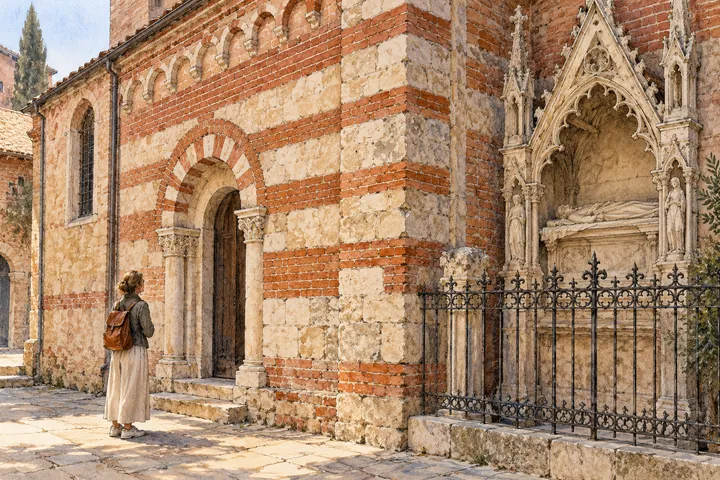
Start outside with the overall building rather than hunting immediately for the oldest stone. Notice the relationship between the wall surfaces, openings and approach. Then, if entry is available, allow your eyes to adjust and look at how the interior is divided. A few clear observations about proportion and light make a better foundation than a list of architectural terms recalled in a hurry.
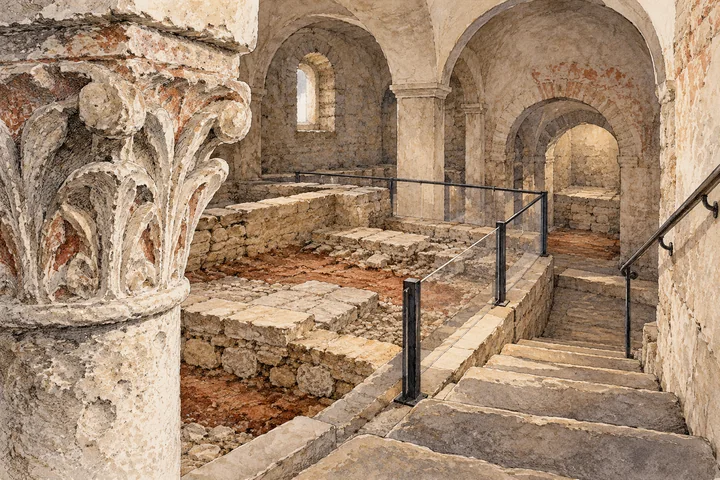
The welcome service’s historical account connects the Romanesque rebuilding with the earthquake of 1117 and describes an earlier history beneath it. That does not mean every visible feature dates to one rebuilding campaign. Ask the guide or consult the interpretation when you want to connect a particular element with a period. The differences between a foundation, a reconstruction and a later repair are part of the story.
Our guide to San Lorenzo offers a useful comparison elsewhere in Verona. Both visits can encourage close attention to Romanesque architecture, but they should not be collapsed into a single template. Look for a difference you can actually describe: an approach, a spatial division, a surface or a change in light. One thoughtful comparison is more memorable than declaring two churches broadly alike.
What should you make of the sarcophagi?
The crypt is associated with two ancient sarcophagi, described in the church’s interpretation as Roman-period works. Their presence invites several separate questions: when were the containers made, what does their decoration show, and how did later communities understand and use them? A carved object can have a history that continues long after its manufacture. Its current religious setting does not erase that earlier life.
Keep devotional tradition distinct from archaeological identification. If a story associates remains with named holy figures, report it as a tradition unless the interpretation establishes a different evidential basis. This distinction does not diminish the meaning a tradition has for worshippers. It simply avoids asking a stone object to prove more than the available evidence supports.
The welcome service’s urban pilgrimage announced for 31 October 2026 is a separately arranged programme, with its own reservation and participation terms. Check the current event information if that is your interest; a dated announcement does not guarantee places remain available. Ordinary church visiting and an organised event are different arrangements, even when both involve the same building.
How can you keep the visit respectful and manageable?
Follow the guidance given on arrival, particularly around the crypt and any restricted spaces. Keep voices low, avoid obstructing worshippers and ask about photography rather than assuming it is unrestricted. A photograph may help you remember a detail, but it is not worth blocking a narrow route or leaning over a protective boundary. Leave yourself time to look without the camera as well.
Place the church within a slower walk through Veronetta, allowing for the actual terrain and the opening you have confirmed. If you are also interested in the Villa Romana di Valdonega, arrange that separately; its surviving rooms have their own access procedure. The presence of Roman material at both sites does not make one an alternative entrance to the other.
For travellers continuing to Milan, Sant’Ambrogio offers a different opportunity to consider a church’s architecture and long religious history. Our Verona history experiences can help you add a guided city activity, with the precise itinerary checked before booking. San Giovanni in Valle asks for no frantic schedule: confirm the visit, distinguish evidence from tradition, and give a compact place enough attention to remain distinct in your memory.
Sources & further reading
Turn a good read into a great day.
Find a highly rated Veronese experience that brings these stories to life.
Explore related experiences →