Verona’s San Lorenzo: what can a small Romanesque church teach you to see?

A smaller church can make architecture easier to read. Instead of confronting a long list of celebrated works, you can follow a few relationships: a column beside a heavier pier, an upper opening above a lower one, a pale course of stone beside a red course of brick. At San Lorenzo in Verona, those details offer a rewarding way to understand how a room is put together.
The official tourism description places the church between Corso Cavour and the Adige. It is a useful reminder to find the actual entrance rather than expecting a major monument to announce itself from every direction. Begin with the building’s modest urban setting, then let the interior change your sense of scale.
Read the room before the individual artwork
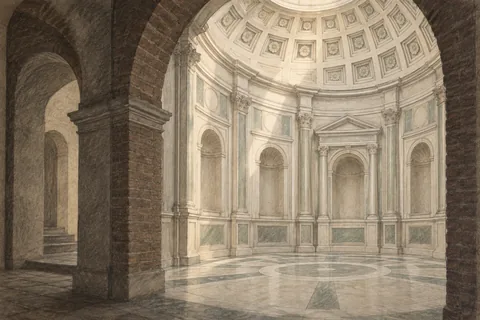
The Church of Italy’s diocesan building record describes three aisles, alternating columns and substantial piers, and galleries above the side aisles. Use that description as a small looking exercise. Follow one row of supports and notice where the rhythm changes rather than treating every upright element as the same thing.
Then look upward from the public visiting area. The upper galleries make the room more complex than its floor plan alone suggests. You can observe their relationship with the central space without assuming they are accessible to visitors. A visible staircase, doorway or elevated level is not an invitation to enter a restricted area.
Let the masonry slow your eye
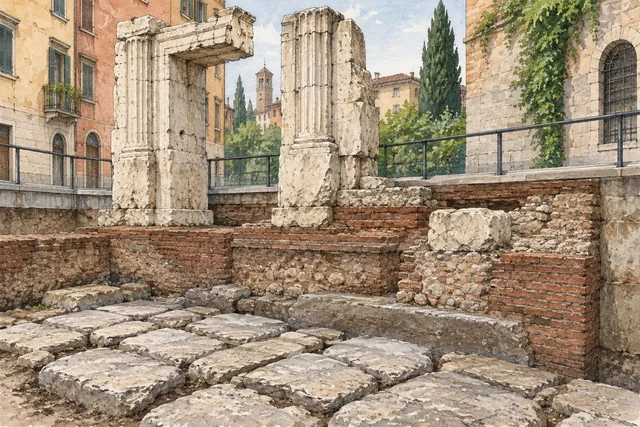
The diocesan record identifies the interplay of tuff, brick and river pebbles in the church’s masonry. From a respectful viewing distance, look for changes in color and texture. A wall can be a patterned surface and a structural system at the same time; noticing one does not require ignoring the other.
Try describing a small section without immediately assigning it a date. Where are the joints, and which lines continue across a change of material? If you later consult a plan or an explanatory panel, you will have a specific observation to connect with it. Our guide to San Zeno offers another opportunity to think about Romanesque architecture at a different scale.
Keep the building’s phases distinct
The diocesan account places the present church in the twelfth century and records earlier origins as well as later decoration and restoration. Its explanation of a pause in construction is qualified, including possible causes. Preserve that uncertainty rather than turning a plausible sequence into an exact story that the evidence does not support.
Later work also shapes what visitors encounter today. A medieval-looking interior should not automatically be described as untouched. Ask which features are surviving fabric, which belong to later additions and which were affected by restoration. The answers may be uneven, and that unevenness is part of understanding a historic building honestly.
Compare without flattening the differences
After visiting, compare one feature with another Verona church. At San Fermo Maggiore, the relationship between different church spaces provides another kind of architectural question. Comparing those places does not require deciding which is more authentic or more important; it can simply make each easier to describe.
If your journey also includes Bologna, Santo Stefano’s layered complex offers a further example of why religious sites rarely fit one tidy date. Keep each institution’s admission and visiting arrangements separate. Similar-looking architecture does not imply a shared ticket or the same access rules.
Use the neighborhood as context
San Lorenzo can fit into a focused walk around Corso Cavour, but avoid stacking too many interiors into the same short period. Our article on Porta Borsari introduces a different period of the city nearby. Moving between Roman and medieval evidence can be illuminating when you allow time to register what has changed.
Check the church’s current visiting arrangements through the official listing or its contact details before making it the fixed point of your day. Worship times and visitor access are different matters. Ask directly about steps or other practical needs, follow local photography instructions and leave space for people using the church for prayer.
The Verona history collection can help you compare separately described guided experiences. Whether you visit independently or with a guide, carry away one clear observation about support, surface or space. Learning to see a small building carefully can improve every larger monument you encounter afterward.
Sources & further reading
Turn a good read into a great day.
Find a highly rated Veronese experience that brings these stories to life.
Explore related experiences →