Verona’s Arco dei Gavi: why does an ancient arch stand beside Castelvecchio?

Beside Castelvecchio, the Arco dei Gavi looks settled enough to make its location seem inevitable. It is not. The arch is ancient, but its present placement belongs to a modern reassembly. Knowing that changes the visit from a quick photograph into a small investigation: which part of what you see belongs to the Roman monument, and which part belongs to the story of preserving it?
Verona’s official heritage accounts describe an early imperial monument commissioned by the Gavi family and originally placed along the Via Postumia outside the Roman city. They also record its dismantling in 1805 and reconstruction near Castelvecchio in 1932. Those dates are useful anchors, but the most rewarding part of the visit is learning to keep material and location separate.
Begin with the arch that is actually in front of you
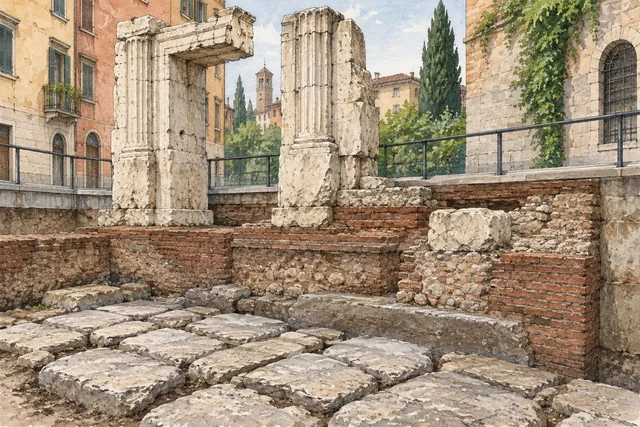
Stand where you can see the whole structure without blocking people passing through the area. Follow the main opening upward, then notice the smaller architectural elements around it. Columns, capitals and niches break a large stone mass into a more varied surface. You do not need to identify every classical order before you can appreciate that arrangement.
Walk to another permitted viewpoint and compare what changes. A monument with several faces can feel quite different from an oblique angle. Keep to public paths and do not climb onto masonry for a better view. The best photograph is not necessarily taken from the position that tells you most about the building.
Separate an ancient object from an ancient setting
The arch’s original roadside location mattered to how it was encountered. Its current position beside a medieval castle creates a different relationship, one that is part of Verona’s later urban history. The monument can contain ancient material without every aspect of the scene around it being ancient or original.
That distinction also applies to the dark paving placed beneath it. The official description identifies a stretch of Roman road surface with wheel marks, but it should not be treated as proof that the arch still stands over its original road in its original position. Look carefully, then let the site interpretation establish the relationship between the pieces.
Give dismantling and reassembly their own history
The 1805 dismantling was followed by the survival and storage of the blocks, which made later reconstruction possible. The twentieth-century rebuilding is therefore an important episode, not an inconvenience to ignore when describing the arch as Roman. Ask what kinds of records and surviving material allow a structure to be put together again.
Do not assume you can identify every replaced or repaired area by colour alone. Weathering, cleaning and lighting can alter appearances. Where interpretation distinguishes an ancient component from later work, use that evidence; otherwise, a question is more accurate than a confident guess. Our Porta Leoni guide offers a contrasting case in which the relationship between street levels and surviving remains is central to the visit.
Compare monuments without making them interchangeable
Nearby Castelvecchio has its own architectural and museum history. The arch can be a focused outdoor stop before or after a museum appointment, but it does not require you to rush through the castle’s collections. Leave enough attention for whichever is your main interest that day.
Further into the city, Porta Borsari provides another way to read a Roman architectural fragment in the modern street. A gateway and a commemorative arch are different kinds of monument. Comparing their present surroundings is useful precisely because their functions and later histories should not be collapsed into one generic Roman story.
Make a short stop count
Allow a few quiet minutes to look from more than one angle, read the interpretation and notice how people move around the monument now. Check the immediate route for uneven surfaces if that matters to your group. Outdoor access can be affected by works or temporary restrictions, so follow current signs rather than an old photograph of an unobstructed approach.
For guided context, compare Verona history experiences and check whether the arch is on the actual route. On a separate Milan stay, the San Lorenzo columns prompt a related question about ancient material in a living city. Here beside Castelvecchio, the useful souvenir is a distinction: the age of the stone, the purpose of the monument and the history of its setting are connected, but they are not identical.
Sources & further reading
Turn a good read into a great day.
Find a highly rated Veronese experience that brings these stories to life.
Explore related experiences →