Why is Castelvecchio more than a castle?
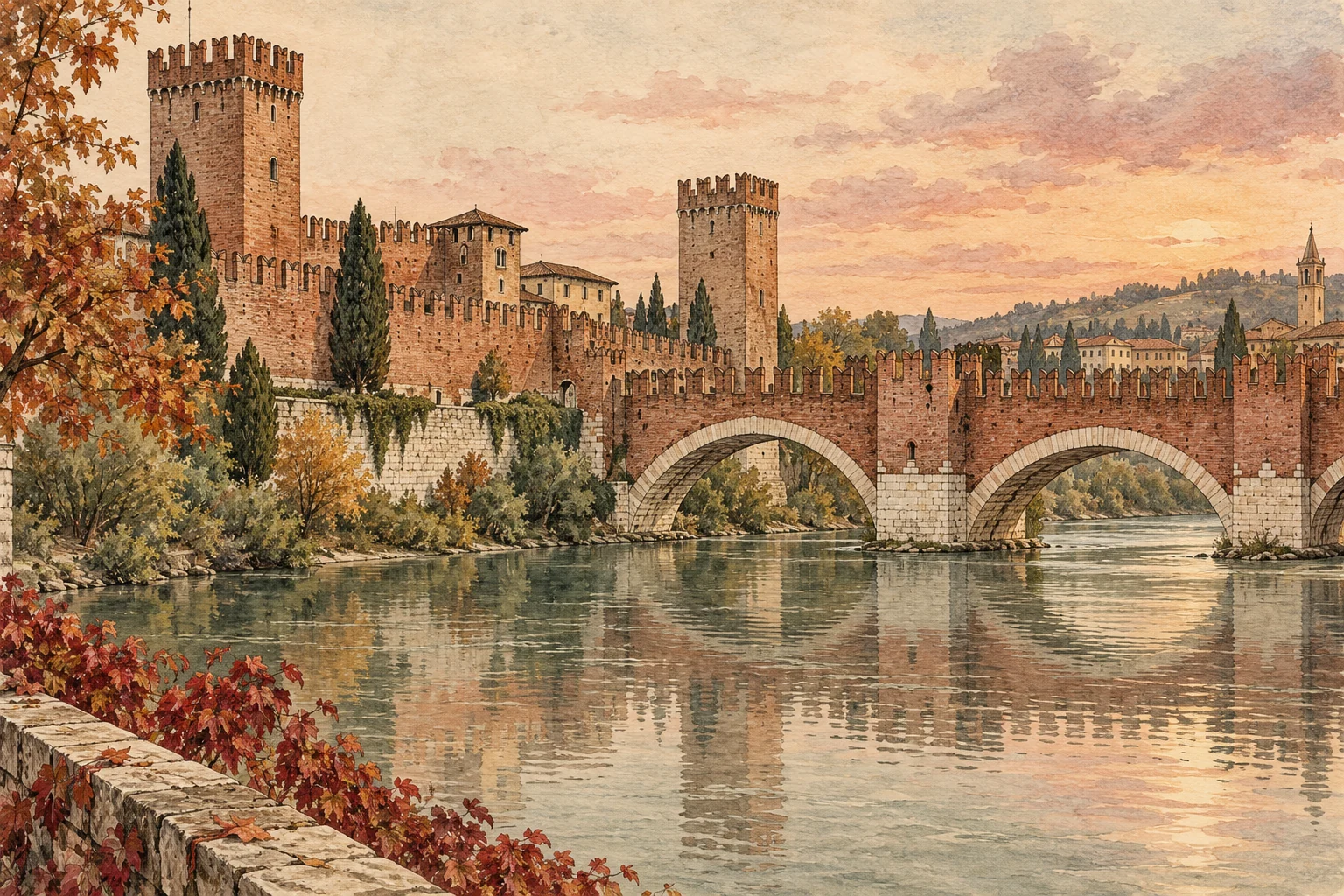
Castelvecchio rewards several kinds of curiosity at once. You can come for a castle, stay for a painting and leave thinking about the precise angle at which a sculpture was placed. Its power lies in that combination. Medieval architecture, museum collections and modern exhibition design are not separate attractions stacked inside one address; they continually change the way you notice one another.
Read the exterior before entering
Start by looking at the building’s relationship with the river and fortified bridge. Towers, walls and enclosed spaces suggest an architecture concerned with control and movement. Resist treating the battlements only as a decorative skyline. Ask where a person approaches, where they are directed and how the structure relates to the water beside it.
A short exterior look can be satisfying on its own, but it does not substitute for the museum if art and design are your main interests. Check the current visitor information to distinguish public approaches, museum admission and any restricted areas. Our Arena and landmarks collection helps compare broader city introductions with experiences that concentrate on particular sites.
Notice the museum as a designed experience
Carlo Scarpa’s work at Castelvecchio is central to its modern identity. The civic museum’s historical account places his intervention within the redevelopment of the museum in the twentieth century. The practical lesson for a visitor is simple: look at how the objects are shown, not only at the objects themselves. A support, opening, change of level or carefully controlled view can shape your encounter with a work of art.
Spend a moment observing a display from more than one position, where the visitor route permits. What becomes visible as you move? How does the surrounding architecture frame the object? These questions do not require specialist vocabulary. They invite you to become aware that a museum visit is an organized sequence of encounters rather than a neutral room full of things.
Give a few works your full attention
Trying to remember every label is rarely the most rewarding strategy. Choose several works that catch your eye and stay with them. Describe what you actually see before deciding what it means: material, gesture, color, scale and the direction of a figure’s gaze. Then read the label and compare the information with your first observations.
This method works particularly well for mixed-interest groups. One person may notice a carved detail, another the painting’s setting, another the display support. Sharing those observations can be more enjoyable than requiring everyone to follow the same specialist agenda. Our rainy-day Verona guide explains how to give a museum enough time without turning a wet day into an indoor endurance test.
Keep restoration in the conversation
Historic buildings do not reach us without maintenance, reconstruction and decisions about what to preserve. Castelvecchio makes that general truth especially interesting because the museum’s presentation asks you to notice relationships between different periods. Avoid assuming that a surface which looks old and a support which looks modern belong to one simple before-and-after story.
The official museum history is a useful starting point for identifying the relevant stages. If you book a guide, ask how the building’s changing functions affected the way it was used. A good answer should distinguish documented evidence from an appealing anecdote. Curiosity becomes more satisfying when it is also precise.
Make the visit fit the rest of Verona
A museum demands a different kind of energy from an exterior walk. Give yourself a meal or a quiet pause afterward rather than immediately scheduling another concentrated interior. The nearby river can offer a welcome change in scale: after close attention to artworks, you can look across water and let the wider city return.
Our first-day plan suggests treating Castelvecchio as one afternoon direction, not an extra squeezed between every other landmark. If you are continuing to Venice, the sister Venice arts and culture guide offers a useful change of setting for a journey interested in art and architecture.
Leave with one good question
Before you leave, choose one display or architectural moment you would like to understand better. A photograph where permitted, a short note or the name of an artist can provide a starting point for later reading. You need not emerge with a complete history of the collection. Leaving with a sharper eye and a specific question is already a successful museum visit.
Sources & further reading
Turn a good read into a great day.
Find a highly rated Veronese experience that brings these stories to life.
Explore related experiences →