Porta Leoni in Verona: how can you read the Roman street below?

At Porta Leoni, Verona’s Roman past appears in two directions: in surviving masonry incorporated into later buildings, and below the level of the present street. That makes the site especially useful for understanding how an old city is encountered in fragments. You do not need an underground tour to begin looking. The first task is simply to connect what remains above ground with what is visible from the public viewing area.
The official destination account places the gateway on the Roman city’s principal north–south route, the cardo. It describes an earlier brick-and-tuff structure followed by a more richly decorated stone facing. What survives today is only part of a larger gateway complex. Resist the temptation to treat the visible facade as the whole original building.
Look at the street before the ancient stone
Start by noticing your own position. You are standing in a living city, with doorways, pedestrians and ordinary traffic arrangements around you. Find a safe place to pause without blocking anyone. Then look at how the ancient fragment sits within its later surroundings. Does it appear separate, or has the newer building absorbed it into a wall?
This is a useful distinction from a monument displayed in isolation. A fragment that remains embedded in the city can tell you about survival and reuse as well as original construction. It cannot, by itself, explain every change that occurred around it. Use the official interpretation to separate visible evidence from the parts of the story reconstructed by historians and archaeologists.
Compare facade and foundations
The destination description identifies remains beneath Via Leoni that include parts of the gateway’s side wall, courtyard paving and tower foundations. One tower base is visible in the open excavation; other remains are not simply available to wander through. The public view is therefore selective. An archaeological description of an area is not permission to enter it.
From a permitted position, compare the size of the visible masonry with the scale of the street above. Try to imagine the space a gateway required without drawing a complete building in your head too quickly. The decorative front and the structural footprint answer different questions. One helps you think about appearance; the other makes you consider depth, circulation and the boundary of the city.
Let a drawing explain what the stones cannot
If interpretation panels or a current official plan are available, use them after your first look. Find the surviving parts on the diagram before studying the reconstructed outline. That order prevents a convincing drawing from becoming confused with something still standing. In a notebook, use a solid line for what you can actually see and a dotted line for what the interpretation asks you to reconstruct.
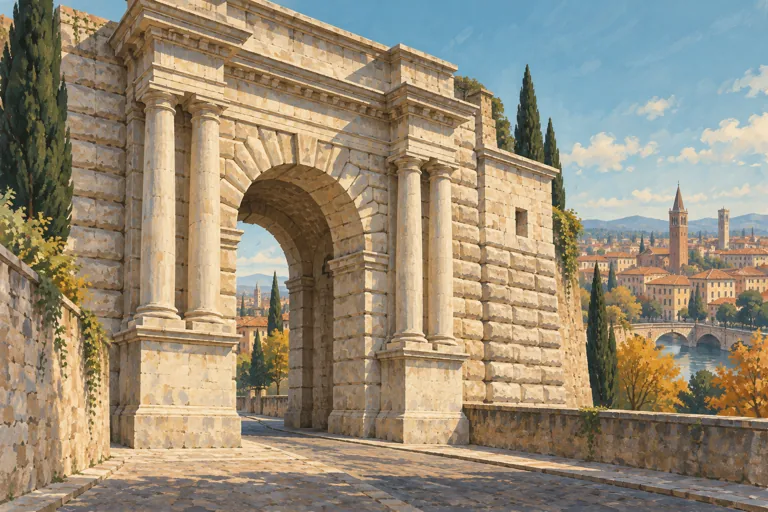
The illustration accompanying this article is an interpretive study of urban layers, not a reconstruction of Porta Leoni. The same care applies to photographs taken from unusual angles: they can make fragments look closer together or more complete than they are. A good visit keeps evidence, explanation and imagination in a friendly but clear relationship.
Follow one route through Roman Verona
Our guide to Porta Borsari introduces a useful comparison, but the two gateways should not be treated as identical survivors. Look for differences in what is visible and how each sits within the modern city. The wider article on Roman Verona beyond the Arena helps place these fragments in a broader walk.
You could continue toward San Fermo Maggiore for a different lesson in architectural layers, checking the church’s own visiting arrangements. Keep the route short enough to notice changes rather than spending the whole day reaching the next pin on a map. Looking at two places carefully can reveal more than passing six without stopping.
Keep access claims and ticket decisions separate
View the excavation from the authorised public areas and follow any temporary barriers or works notices. Do not climb a railing or assume a visible lower level is open to visitors. Uneven surfaces, glare and wet weather can all affect how comfortably you see the remains. If step-free movement matters, check the current route and choose your viewing position accordingly.
For another city’s surviving gateway, Turin’s Porta Palatina makes an interesting comparison on a separate northern Italy stop. For local interpretation, explore Verona history experiences, reading the actual route and admissions. An Arena sightseeing visit and a performance are separate arrangements; neither follows automatically from choosing a Roman-history walk. At Porta Leoni, the most useful discovery may be learning to notice how much history remains visible beneath an ordinary city day.
Sources & further reading
Turn a good read into a great day.
Find a highly rated Veronese experience that brings these stories to life.
Explore related experiences →