Verona’s San Nicolò all’Arena: why does its façade have a separate history?

Near Verona’s Arena, San Nicolò all’Arena invites a useful question: does a church’s façade necessarily belong to the same story as the building behind it? Here, the answer is particularly interesting. The front has a history of reuse, while the church itself belongs to an earlier building project. It is an excellent place to practise separating the date of a structure from the date of the face it presents to the city. This is Verona’s San Nicolò, not the similarly named church in Catania.
Why does the façade need its own timeline?
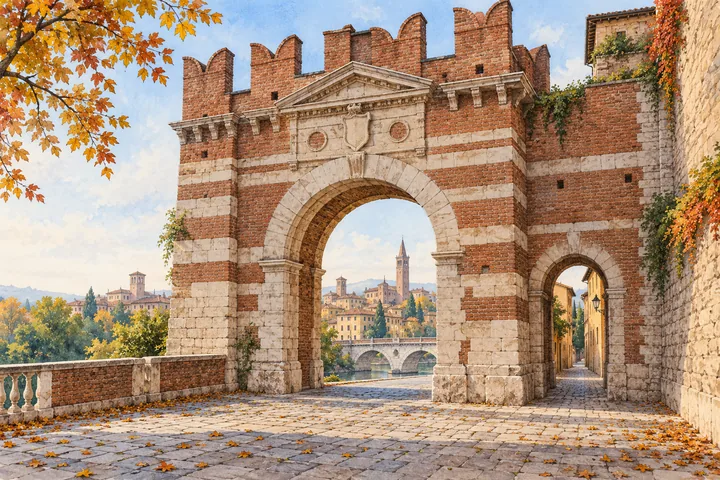
The restoration contractor Roma Consorzio’s project account explains that the seventeenth-century church, designed by Lelio Pellesina, originally lacked a completed façade. Its present front incorporated material from San Sebastiano, damaged during the Second World War, in an early-1950s intervention associated with Piero Gazzola. The account also records later conservation campaigns. That is a story of deliberate reuse, not evidence that the entire church was built when its present front was assembled.
Stand far enough back to read the composition, while keeping clear of doors and pedestrian movement. Notice the order created by columns, openings and the upper outline. Then ask what your eye can and cannot tell you. You can describe proportions and materials; you cannot reconstruct the precise sequence of transfer and installation from appearance alone. The documentary history supplies information that the stone does not announce by itself. This makes the façade more interesting, rather than less authentic as an object of study.
Is reuse the same thing as restoration?
Not quite. Reuse places existing material in a new arrangement or setting. Restoration and conservation address the condition and interpretation of something already there. A building may have experienced both. Roma Consorzio describes work to the church’s surfaces in the 2010s, including attention to surviving evidence on the northern side. Avoid collapsing these activities into the vague claim that the church was simply rebuilt. A careful description distinguishes the earlier structure, the transferred façade and subsequent care.
Verona offers other opportunities to think about survival and intervention. Our guide to Ponte Scaligero considers a reconstructed bridge, while Palazzo Barbieri prompts a different discussion about classical architectural language. Similar-looking forms do not necessarily indicate the same date, function or response to damage. The comparisons are most useful when you keep those differences visible.
What about the bell tower?
The local Scuola Campanaria Verona’s account describes the church’s seventeenth-century project and the unfinished tower, including a twentieth-century proposal that did not reach completion. A partial structure can be historically informative. Rather than treating it as an unfortunate gap in your photograph, ask how an unrealised plan changes what a visitor sees. Do not imagine a finished outline as a factual reconstruction unless the evidence specifically supports it.
The tower’s history also reminds us that a city is full of decisions that were altered or abandoned. Travel writing often favours completed masterpieces, but buildings can preserve interrupted ambitions just as clearly. Keep your observation modest: identify the visible element, read the documented account and leave the rest open. There is no need to invent a climb, a viewing platform or a visitor route simply because a tower appears on the skyline.
Can you combine a church visit with an Arena experience?
You can plan them within one Verona day, but their access arrangements remain separate. Our guide to Arena sightseeing and opera performances explains why a daytime visit and an actual show are different purchases. A nearby church does not become part of either ticket by proximity. Check San Nicolò’s own current arrangements, respect worship and do not assume that an open door permits wandering into every adjoining space.
Concert notices need the same attention to dates. The municipality’s 2026 historic-organ festival listing covers a programme ending on 26 October. As of this article’s 29 October publication, that listing is past evidence, not a promise of an upcoming performance. Look for a newly dated programme before making an evening plan. In another city, Milan’s San Maurizio offers a further lesson in reading a church’s spaces without assuming unrestricted access.
For guided options, browse the Verona experience collection and read the itinerary and meeting point. A city walk may discuss San Nicolò from outside; that does not imply interior admission or concert entry. With these boundaries clear, the façade becomes a particularly rewarding short stop: a visible reminder that architectural history includes movement, repair and decisions made long after the first foundations.
Sources & further reading
Turn a good read into a great day.
Find a highly rated Veronese experience that brings these stories to life.
Explore related experiences →