Verona’s Arsenale Austriaco: how do you plan around changing public access?

Verona’s Arsenale Austriaco is an invitation to look beyond the city’s ancient and medieval landmarks. Its nineteenth-century military architecture occupies a substantial piece of the urban landscape, and its changing civic use adds another chapter. For a visitor, the useful starting point is a clear distinction between what can be observed from a permitted public route and what a restoration project proposes for the future. A compelling drawing of a future park is not an opening announcement.
What is the current practical complication?
A municipal notice dated 25 September 2026, checked on 4 November, announces district-heating excavation in Piazza Arsenale through the end of the year, with changes to traffic and parking. That is a concrete reason to consult current municipal updates and signs before choosing an approach. It does not, by itself, establish that every part of the arsenal is closed or open.
Keep an outdoor visit flexible. If an approach is fenced or redirected, follow the designated public route and choose another viewpoint. Do not interpret an open works gate as visitor access. Anyone needing a step-free route should ask about the actual current approach, including temporary surfaces and crossings. A general description of a park cannot answer those questions during changing works.
Place the architecture in its own century
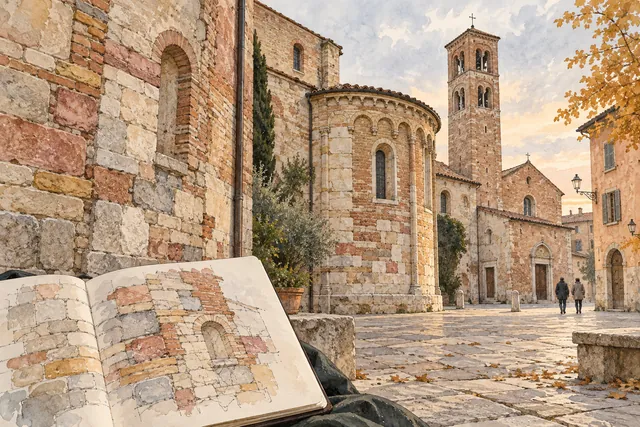
The city’s heritage account on the national Art Bonus portal dates construction to 1854–1863, during Habsburg rule, and describes a complex of roughly 6.9 hectares. It identifies a round-arched architectural language associated with Rundbogen design, expressed through brick and local Avesa stone and drawing on Verona’s Romanesque traditions. A building can therefore look back to older architecture while belonging firmly to the nineteenth century.
Start with that puzzle rather than hunting for a medieval date. Look for repetition: openings, bays, contrasting materials and the rhythm of a long elevation. Then ask how the same design vocabulary works across a large complex. Repetition can make an institution legible and give separate buildings a common identity. That is an observation about the visible arrangement, not proof of the purpose of an unidentified room.
How does scale change the way you look?
A large military complex cannot be understood in the same way as a single decorative doorway. From a lawful place where you can pause, compare one architectural detail with the larger pattern around it. A rounded arch may be easy to photograph, while the spacing between buildings or the relationship with an open court asks you to look more broadly.
Do not try to complete a perimeter circuit simply to feel that you have “done” the place. Current access may make a partial view the sensible choice. One carefully considered elevation can reveal more than a hurried sequence of photographs taken around barriers. If a project panel provides a plan, distinguish the existing layout, the proposed layout and the route actually available to visitors.
Recognize alteration without guessing its date
The Art Bonus account records wartime damage and later rebuilding and internal changes. It also locates the arsenal between Borgo Trento and Castelvecchio, helping explain its importance in the city’s wider development. This documented history cautions against treating every visible surface as untouched nineteenth-century fabric. At the same time, a patch of different colour does not allow a visitor to date a repair independently.
Use visible differences as questions. Does an opening appear blocked? Does a surface change at a particular line? Is an explanation provided? Note what you can observe, then use the responsible institution’s account for attribution and chronology. Restoration is often visually complex, and a neat story about “original” and “new” can be less accurate than acknowledging several phases.
Keep future uses in the future until they open
The municipality’s archived restoration notice describes the Ars District project and its separate interventions. Such documents explain ambitions, responsibilities and stages of work. They do not substitute for visitor information about a particular room, exhibition or public event. A space planned for cultural use should not be added to a present-day itinerary until its opening and access arrangements have been confirmed.
If an event is advertised at the arsenal, read that event’s location and admission details carefully. Access for a named programme may cover only one area. It does not necessarily unlock other courts or buildings, and a public-space walk does not become a guided architectural visit by association. Choose the experience that is actually available on your date.
Connect the arsenal with one other Verona story
Our Ponte Scaligero guide considers reconstruction in a different setting. The Bastione delle Maddalene article examines changing fortifications, while Porta Palio introduces a Renaissance gateway. Pick one comparison and preserve the different dates and purposes; not every large wall tells the same military story.
The Verona history collection can help identify guided options with explicit routes. For another northern city, Turin’s Parco Dora guide explores a separate example of older structures entering public space. At the arsenal, a thoughtful visit combines architectural curiosity with present-day access information. You can understand a place in transition without pretending that the transition is already complete.
Sources & further reading
Turn a good read into a great day.
Find a highly rated Veronese experience that brings these stories to life.
Explore related experiences →